


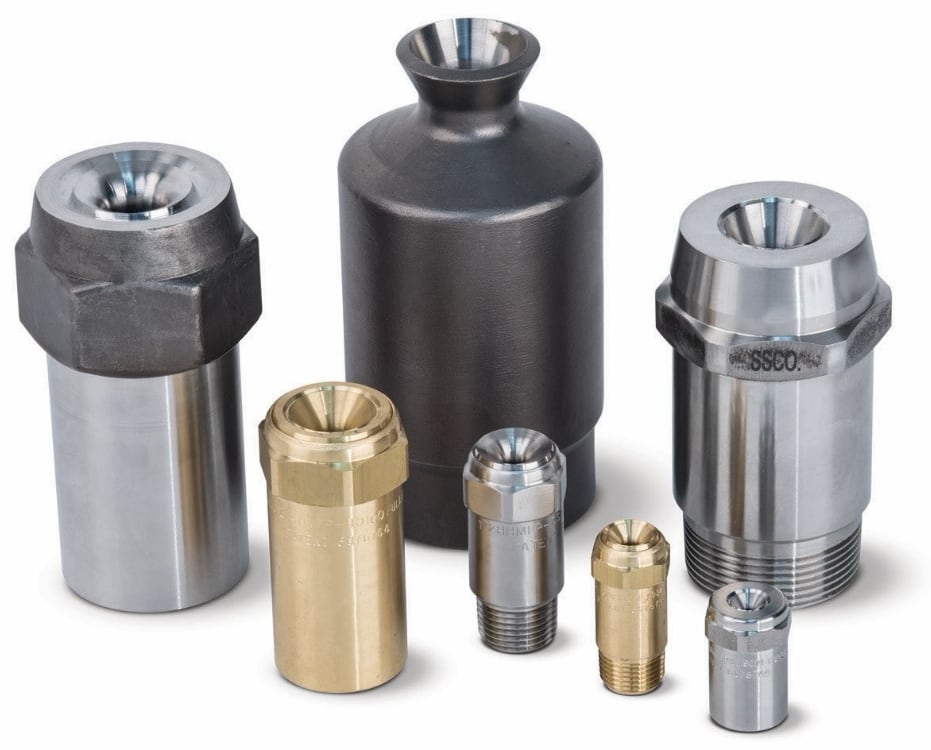
Industrial spray nozzle applications
1. Cleaning and Washing This is one of the most widespread uses. Flat fan, solid stream , and full cone spray nozzles deliver high-impact sprays for removing dirt, residues, scale, or contaminants. Common examples include car washes, industrial parts cleaning, conveyor belts, tank rinsing (CIP systems), high-pressure washing, bottle washing, and food processing sanitation.
2. Cooling and Quenching Spray Nozzles (often full cone or hollow cone) distribute liquid evenly for heat dissipation. Key uses: cooling hot steel/metal in mills (e.g., roll cooling, continuous casting), product cooling in manufacturing, evaporative cooling in cooling towers, gas cooling, and quenching processes. This is critical in steel, power generation, and chemical industries.
3. Coating and Surface Treatment Air atomizing, flat fan, or specialized spray nozzles apply paints, chemicals, adhesives, lubricants, fertilizers, or protective coatings uniformly. Prominent in agri, automotive painting, food coating/flavoring,bakery, paper/textile finishing, and pharmaceutical tablet coating.
4. Dust Suppression and Pollution Control Hollow cone or fine mist/fog spray nozzles create droplets that capture dust particles or scrub gases. Widely used in mining, material handling, power plants (flue gas desulfurization), and environmental control for air pollution reduction.
5. Humidification and Mist/Fog Applications Fine atomizing or mist spray nozzles control humidity or create evaporative effects. Common in textiles (to prevent static/breakage), greenhouses, warehouses, spray drying (food/pharma), evaporative cooling, and fire protection (suppression/misting systems).
These applications dominate due to the versatility of spray nozzle types (flat fan, full/hollow cone, atomizing, etc.) in optimizing droplet size, spray pattern, impact, and coverage. Other common spray nozzle applications include lubrication, fire protection, chemical injection, and gas scrubbing, but the above five are the most common . Spray nozzle selection in each of the above applications depends on factors like pressure, flow rate, droplet size, material compatibility, and specific process needs.